
Let’s be honest. Most of us know we should move more, but “move more” sounds vague and boring. This is exactly where an Activity Points Calculator earns its place. It turns daily movement into clear, trackable points that actually mean something.
Instead of guessing whether today’s walk, workout, or chores “counted,” an activity points calculator gives you a logical score based on effort, duration, and intensity. Simple idea. Smart execution.
In this guide, we’ll break down activity points in a clean, human way-no fluff, no fake claims, and no scary math. You’ll understand how activity points work, why they are trusted, and how to use them properly.
What Is an Activity Points Calculator?
An Activity Points Calculator is a tool that converts physical activities into numerical points. These points reflect how much effort your body uses during different activities.
The calculator usually considers:
- Type of activity
- Duration (minutes or hours)
- Intensity level
- Body weight (in some cases)
Instead of focusing only on steps or calories, activity points provide a broader and more flexible way to measure movement.
Think of it as a universal language for physical activity.
Why Activity Points Exist And Why They’re Logical?
Counting steps works-until it doesn’t. Cycling, swimming, yoga, and strength training don’t always show up accurately in step counts.
Activity points solve this problem by focusing on energy expenditure, not just motion.
Most calculators rely on MET values (Metabolic Equivalent of Task). METs come from the Compendium of Physical Activities, a widely accepted scientific reference used by health researchers and fitness professionals.
According to this system:
- 1 MET = energy used at rest
- Higher METs = higher effort
This method allows fair comparison between different activities without guessing.
How an Activity Points Calculator Works?
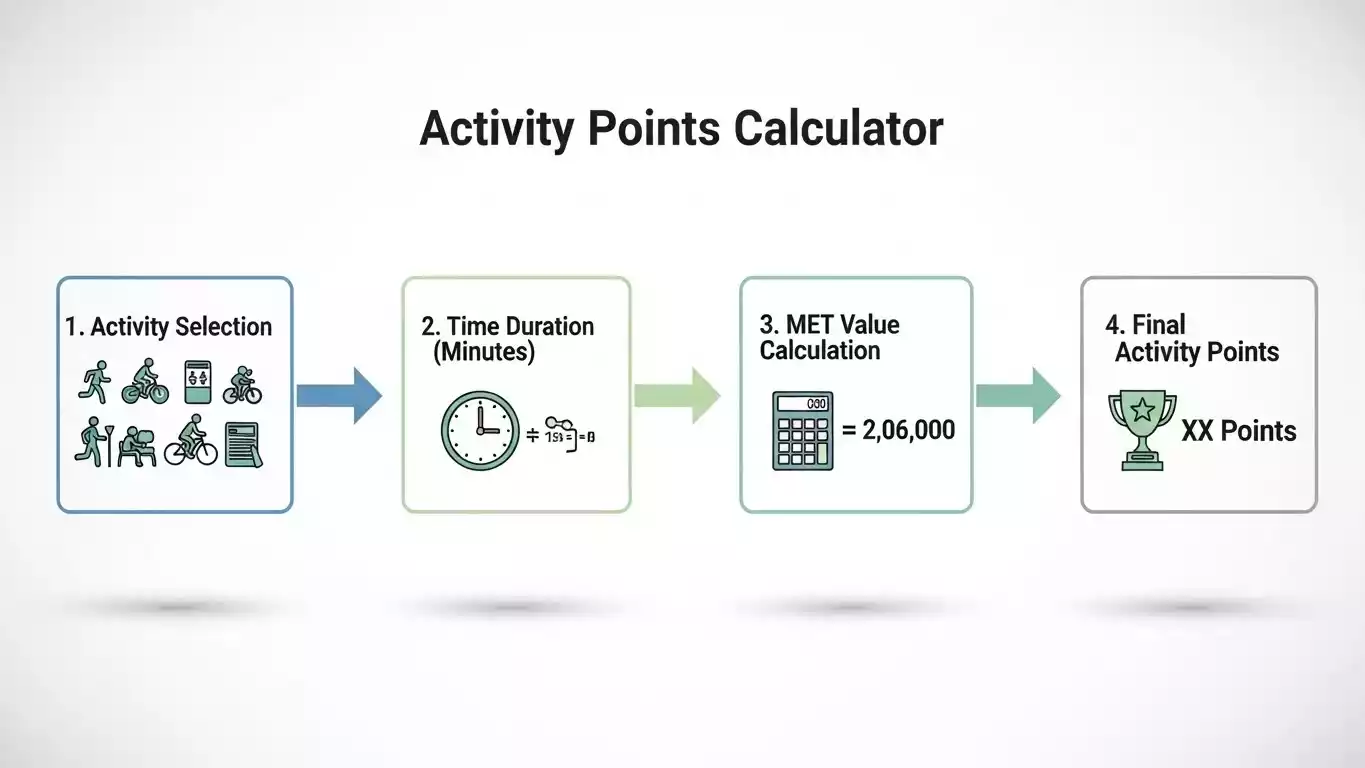
Here’s the logic in simple terms:
- Each activity has a MET value
- The calculator multiplies METs by time
- Some calculators adjust for body weight
- The final number becomes your activity points
No magic. No random scoring.
This approach aligns with guidelines used by organizations like:
- CDC (Centers for Disease Control and Prevention)
- WHO (World Health Organization)
- American College of Sports Medicine
These institutions recommend tracking moderate to vigorous activity, not just steps.
Common Activities and Their Typical Point Logic
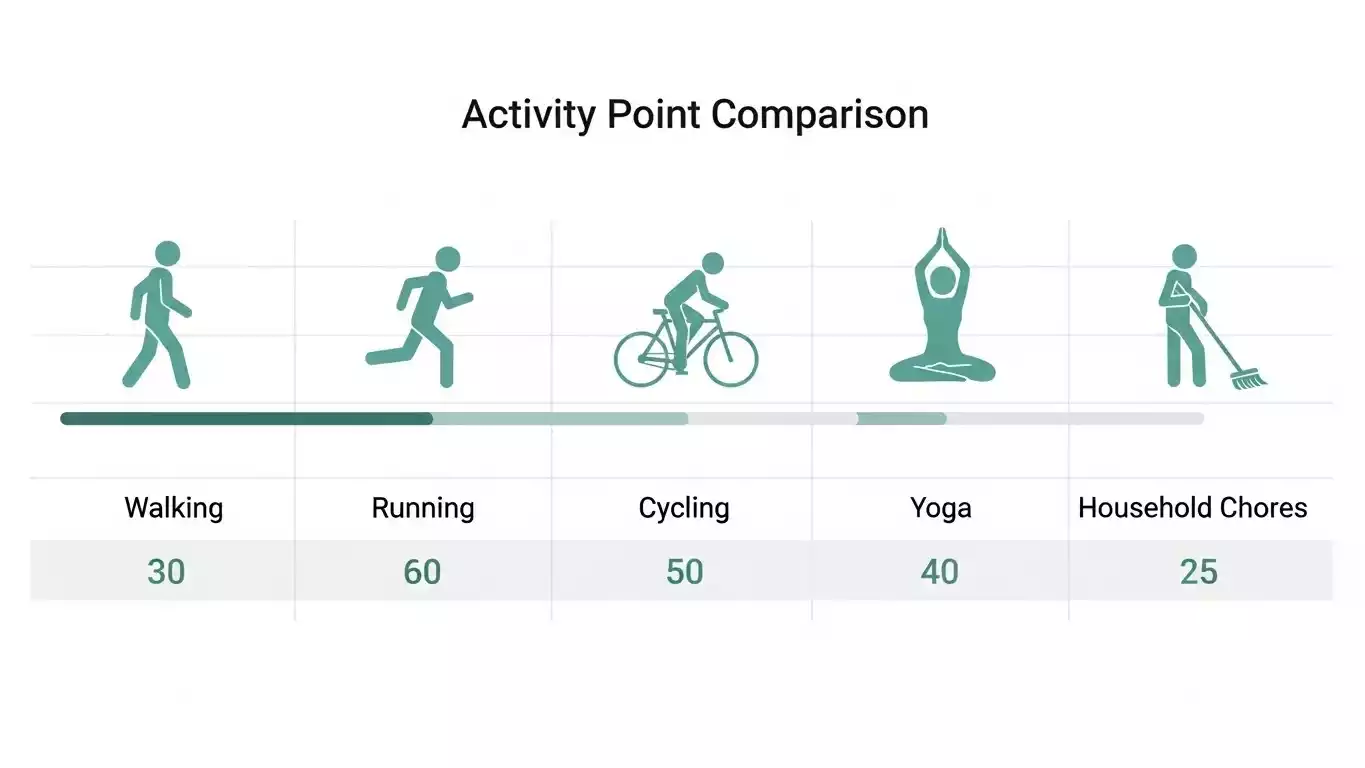
While exact points vary by calculator, the structure remains consistent.
- Walking (moderate pace): steady points
- Running: higher points in less time
- Cycling: points based on speed and resistance
- Strength training: moderate to high points
- Household chores: lower points, but still valid
Yes, cleaning your house counts. Your vacuum just became a fitness partner.
Activity Points vs Calories: What’s the Difference?
Calories focus on energy burned. Activity points focus on effort and health impact.
Calories can:
- Vary wildly between people
- Confuse beginners
- Encourage unhealthy obsession
Activity points:
- Feel more neutral
- Encourage consistency
- Support long-term habits
That’s why many wellness programs prefer points over calories.
While activity points focus on overall effort and consistency, users who want a more energy-based perspective can also explore our calories burned calculator to better understand how different activities impact daily energy expenditure.
Who You Should Use an Activity Points Calculator?
Short answer: almost everyone.
This tool works well for:
- Beginners starting a fitness routine
- Busy professionals with mixed activities
- People who dislike calorie tracking
- Users following wellness programs
- Anyone who wants clarity without pressure
You don’t need to be an athlete. You just need to move.
How Accurate Are Activity Points?
Accuracy depends on input quality and scientific references.
Reliable calculators base their data on:
- MET values from peer-reviewed research
- Public health recommendations
- Transparent formulas
They won’t predict exact energy burn, but they accurately reflect relative effort, which matters more for habit-building.
Per CDC guidelines, consistency matters more than precision.
Benefits of Using an Activity Points Calculator
1. Encourages Daily Movement
Points make activity feel achievable. Ten minutes still earns something.
2. Supports Variety
You can switch activities without losing progress.
3. Easy to Understand
Points feel friendlier than calories or complex metrics.
4. Goal-Oriented
Weekly or daily point goals feel realistic.
5. Less Mental Stress
No guilt. No obsession. Just numbers with context.
Activity Points and Public Health Guidelines
Health authorities recommend:
- 150 minutes of moderate activity per week, or
- 75 minutes of vigorous activity
Activity points align well with these guidelines by converting time and intensity into comparable values.
This makes it easier to see whether you meet recommended activity levels without doing mental math.
Can Activity Points Help With Weight Management?
Yes-but indirectly.
Activity points support:
- Better consistency
- Higher awareness
- Sustainable routines
Weight changes depend on many factors, including diet, sleep, and genetics. Activity points don’t promise weight loss, and that’s a good thing.
They focus on behavior, not pressure.
Common Mistakes to Avoid
Even smart tools need smart use.
Avoid these mistakes:
- Overestimating activity intensity
- Ignoring rest days
- Chasing points instead of balance
- Comparing your points to others
Your body isn’t a leaderboard.
How to Use an Activity Points Calculator Correctly?
Follow these simple rules:
- Be honest with activity duration
- Choose the closest activity type
- Stay consistent with the same calculator
- Track weekly trends, not daily spikes
Small actions add up faster than you think.
Activity Points for Different Lifestyles

Office Workers
Short walks, stairs, stretching sessions all matter.
Students
Sports, cycling, and daily movement earn points easily.
Home-Based Workers
Housework, quick workouts, and active breaks count.
Fitness Enthusiasts
Use points to balance intensity and recovery.
The system adapts to you-not the other way around.
Are Activity Points Scientifically Supported?
Yes.
The foundation comes from:
- Compendium of Physical Activities (Ainsworth et al.)
- CDC physical activity guidelines
- WHO global activity recommendations
These sources form the backbone of many fitness trackers and wellness platforms used worldwide.
No guesswork. Just applied science.
FAQs About Activity Points Calculator
What are activity points exactly?
Activity points measure physical effort based on activity type, duration, and intensity using scientifically accepted values.
Are activity points better than step counting?
They offer more flexibility because they include non-step activities like cycling, swimming, and strength training.
Do activity points replace calories?
No. They serve a different purpose. Points focus on consistency and effort, not energy intake.
Can beginners use an activity points calculator?
Absolutely. The system works especially well for beginners because it rewards all movement.
How many activity points should I aim for daily?
There’s no universal number. Many programs suggest weekly goals aligned with public health activity recommendations.
Are activity points medically accurate?
They are behaviorally accurate, not diagnostic tools. They reflect effort based on validated MET data.
Can I trust online activity points calculators?
Yes, if they use transparent formulas and reference established activity data sources.
Final Thoughts: Why Activity Points Actually Work
The Activity Points Calculator succeeds because it respects human behavior. It doesn’t shame you, it doesn’t overwhelm you. It simply translates movement into meaning.
When fitness feels logical, people stick with it.
If you want a practical, science-backed way to track activity without stress, activity points offer a smart solution. No hype. Just honest math, real movement, and progress you can understand.
If you regularly track wellness metrics, our collection of fitness and health calculators can help you monitor physical activity, energy use, and overall lifestyle habits in one place.
And yes-your chores count. Enjoy those points.